Brazilian woman with twin brother’s blood gives birth to son
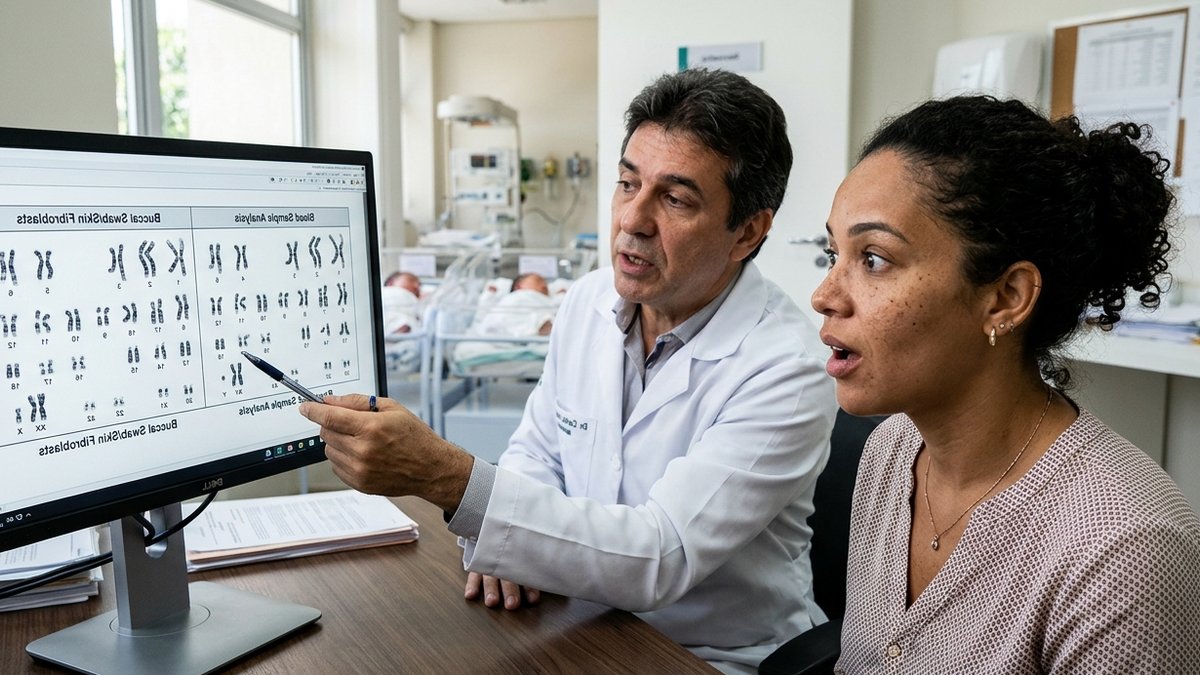
Sharing a uterus and circulation with a male twin typically produces a sterile female calf known as a freemartin. This fact makes a specific case stand out: a 35-year-old Brazilian woman whose blood matched her twin brother’s. Despite a similar prenatal blood exchange, she developed normally and gave birth to a healthy son.
Doctors in São Paulo described her case in Gene Reports in 2025. Her blood cells carried an XY chromosome pattern matching her brother, while her other tissues were XX. Early attention focused on implications for DNA testing, but the contrast with cattle is equally notable.
A Century-Old Cattle Puzzle
The freemartin mystery was largely solved a century ago. Between 1914 and 1920, University of Chicago zoologist Frank Lillie studied 97 cattle uteri containing twins, according to the Arizona State University Embryo Project. He found that the freemartin and her brother came from separate eggs but shared blood circulation through the membranes surrounding them.
Lillie proposed that hormones from the male twin traveled through that shared circulation and disrupted the female’s sexual development. Because the testis develops earlier than the ovary, he argued, the male’s hormones reached the female first. Later DNA analysis confirmed that freemartins are genetically female. The effect is dramatic: in more than 90% of cases, a heifer born twin to a bull is completely infertile, while the bull is affected only by reduced fertility.
Ranchers are advised to check such heifers around weaning to avoid raising an animal that cannot breed. The Brazilian woman‘s case came to light after an early pregnancy loss. Two separate chromosome tests on her blood showed 46, XY, the typical male pattern, in every cell examined. Cells from her urine, cheek lining, and skin were 46, XX.
DNA markers and immune-system typing showed that her blood matched her fraternal twin brother. The paper describes her as having normal sexual development and ovarian function. Its authors also reported an unusual genetic twist in her blood — a reshuffled stretch of immune genes inherited from her mother — which they called the first case combining complete blood chimerism with that kind of genetic recombination and a mismatch between tissues.
The pair were born at 35 weeks, and her brother had severe anemia after birth that required a transfusion, according to the paper. This fits the explanation the researchers favor: blood exchanged through connected blood vessels before birth, known as twin or transfusion chimerism.
Her menstrual periods began at 13 and were regular, co-author Gustavo Maciel of the University of São Paulo told Live Science. He said the pregnancy loss happened at seven weeks and that, about 11 months later, she conceived again and delivered a healthy boy.
Humans Are Not Always Spared
The paper notes freemartinism as the cattle counterpart of this phenomenon, but its published summary does not explain why her development was spared. Lillie’s hormone theory was built on cattle, and researchers have not shown that the same timing or hormone exposure applies to human twins.
Human twins rarely share blood the way cattle twins do. Fraternal twins usually develop separate placental circulations, but a small number share a single placenta — a rare arrangement called monochorionic dizygotic twinning. A 2017 systematic review in Twin Research and Human Genetics found 31 published cases. In 82.1% of pregnancies where the method of conception was documented, the twins had been conceived with assisted reproduction.
Chimerism was confirmed in 90.3% of cases, and the share of blood cells from the other twin ranged from 1% to 99%. Some outcomes resembled cattle. Among boy-girl pairs, 15.4% had a genital anomaly in one twin. In one girl, internal female reproductive structures failed to form, which the review’s authors said could be the first published case of possible freemartinism in a human.
In another case, a healthy girl with a male blood karyotype was diagnosed with a gonadal disorder and had her gonads removed. Her ovaries were normal, highlighting the risk of relying solely on blood tests. The Brazilian case is not the only report of a fertile woman with XY blood. In 2023, doctors at Tehran University of Medical Sciences described a 22-year-old woman in the International Journal of Medical Laboratory whose blood showed a 46, XY karyotype despite spontaneous puberty, regular menstruation, and two pregnancies. Her twin brother had died during the pregnancy.
In 2021, Chinese doctors reported in Frontiers in Genetics a 27-year-old woman seeking help for infertility after a miscarriage. About 93% of the DNA in her blood matched her twin brother. The authors warned that when chimerism is present, blood test results cannot be assumed to reflect other tissues. These isolated case reports do not explain why some women appear unaffected while some twins develop genital anomalies.
Why Some Women Escape the Freemartin Fate
The Brazilian woman’s normal ovarian function and fertility challenge assumptions about shared hormones’ effects. This combination may have influenced her body’s response to hormonal exposure in utero.
Isolated Cases, Unanswered Questions
Each documented case of fertile women with XY blood adds to a growing list of exceptions. The 2023 Tehran report described a woman who conceived naturally twice despite XY blood cells, while the 2021 Chinese case involved a woman whose fertility concerns masked her chimerism until genetic testing revealed a 93% blood match with her brother.


